































by Michael Parker,University at Albany
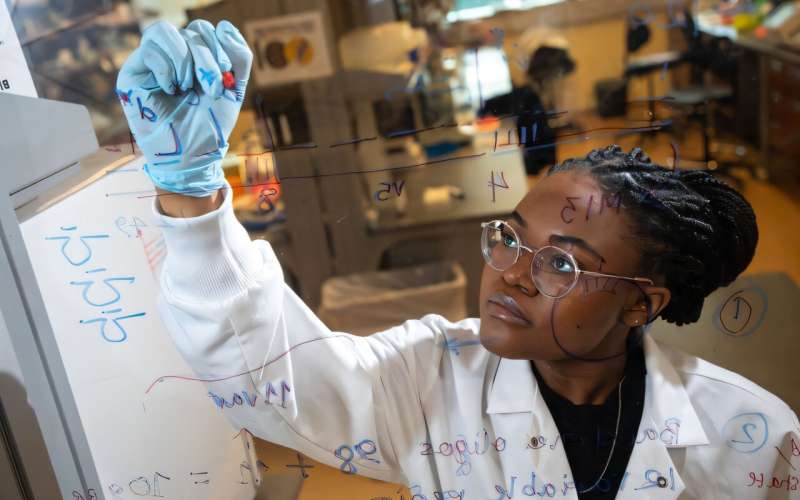
A new UAlbany study outlines why measuring pollutant exposure should be central to research on growth, development, reproduction and chronic disease. Credit: Patrick Dodson
Pollutants can harm human health and enter the body through the air people breathe, the water they drink and the food they eat. Yet even as evidence of widespread exposure has been found in populations around the world, researchers have not consistently accounted for these exposures in studies of human biology.
Now, new research led by UAlbany's Center for the Elimination of Health Disparities is tackling that gap. In an articlepublishedin theAmerican Journal of Human Biology, scientists Lawrence M. Schell and Mia V. Gallo outline why measuring pollutant exposure should be a central component of research on growth, development, reproduction and chronic disease.
"Pollutants are part of the environments people live in every day, and they influence the body in ways we are still working to fully understand," said Schell, a distinguished professor of anthropology and epidemiology and biostatistics. "If we don't measure those exposures, we risk missing an important piece of how health is shaped."
Measuring what the body carries
Rather than presenting new experimental findings, the paper serves as a practical guide for researchers looking to incorporate pollutant exposure into their work. It outlines how different contaminants—including heavy metals, industrial chemicals and airborne pollutants—can be detected in the body using samples such as blood, urine, hair and nails.
The authors note that many large-scale studies still rely onindirect estimatesof exposure, such as proximity to pollution sources or regional environmental data. While those approaches can identify broad patterns, they often fail to capture how individuals encounter pollutants in their daily lives.
That gap matters because different substances behave differently once inside the body. Some reflect recent exposure, while others build up over time and remain for years. Without understanding those differences, researchers may underestimate or misinterpret how environmental factors affect biological outcomes.
"There's no single way to measure exposure that works across the board," Schell said. "You have to match the method to the pollutant and understand what that measurement represents if you want to connect it to health."
The paper also emphasizes the need for interdisciplinary collaboration, bringing together human biologists, toxicologists and laboratory specialists to ensure that exposure data is accurate and meaningful.
Pollutant exposure and health disparities
A central focus of the research is how uneven exposure to pollutants contributes to differences in health across communities. Decades of work by Schell, Gallo and their collaborators have shown that environmental burdens are not distributed equally, with disadvantaged and Indigenous populations often facing higher exposure to multiple pollutants at once.
Those patterns can have real biological consequences. Previous studies have linked pollutants to changes in growth and development, reproductive health and chronic disease risk—effects that may be compounded when exposures overlap.
Gallo said understanding those exposures is essential for addressing broader questions about health equity.
"If we want to understand why some communities experience different health outcomes, we have to look at the environments people are living in," she said. "Pollutant exposure is part of that picture, and it needs to be measured, not assumed."
The work builds on long-standing partnerships with communities, including research conducted with the Akwesasne Mohawk Nation, where residents have raised concerns about how industrial contaminants may be affecting health across generations.
The paper also highlights the importance of working with communities as partners in research, including sharing findings in ways that are clear and useful to participants.
As new chemicals continue to enter the environment and existing pollutants persist, the authors argue that incorporating exposure into human biology research is no longer optional. Doing so, they say, will lead to a more complete understanding of how health is shaped—and help ensure that efforts to reduce disparities are grounded in the realities people face every day.
"If we leave exposure out of the equation," Schell said, "we're leaving out a key part of the story."
Publication details Lawrence M. Schell et al, Integrating Measures of Pollutant Exposure in Human Biology Research, American Journal of Human Biology (2026). DOI: 10.1002/ajhb.70210 Journal information: American Journal of Human Biology






Post comments