































byUniversity of Tsukuba
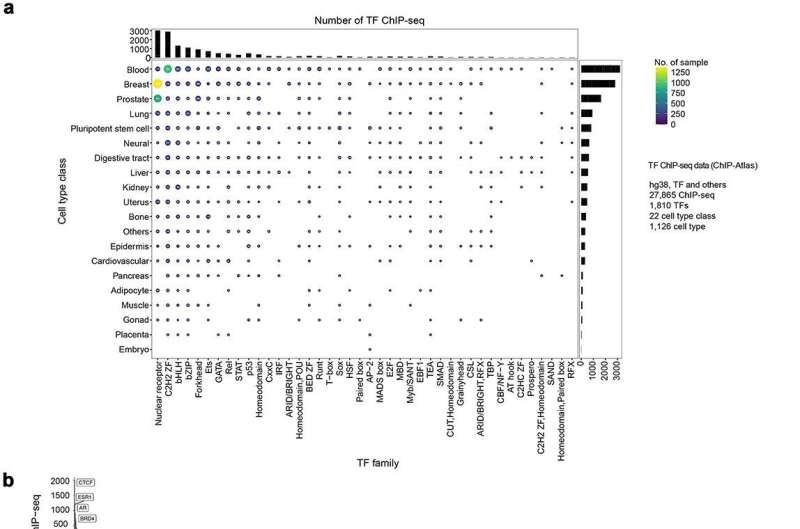
Past and current research attention strongly influences human TF ChIP-seq data. Credit:Briefings in Functional Genomics(2025). DOI: 10.1093/bfgp/elaf016
The human genome contains approximately 1,600 types of transcription factors responsible for regulating gene activity across more than 400 tissue and cell types. Chromatin immunoprecipitation sequencing (ChIP-seq) is a key approach for mapping how these factors interact with DNA to control gene expression.
However, practical limitations, such as the limited availability of suitable antibodies, have hindered efforts to comprehensively characterize transcription-factor binding, leaving many biologically important contexts uncharted.
In this study, researchers systematically analyzed large-scale publicly available human ChIP-seq data to identify highly expressed transcription factor-tissue/cell type pairs whose activity remains unmeasured. They found that althoughblood cellshave been extensively studied far more than other tissues, over 80% of transcription factor-tissue/cell type combinations in organs such as the pancreas, muscle, and placenta has never been measured. This highlights significant gaps in current knowledge, suggesting that essential regulatory mechanisms may have been overlooked.
The findings arepublishedin the journalBriefings in Functional Genomics.
Furthermore, integrated analysis with complementary datasets demonstrated that even unmeasured transcription factors substantially impact gene expression. This indicates that current genomic resources alone are insufficient to capture the entire complexity of human gene regulation.
Moreover,simulation studiesdemonstrated that strategically prioritizing measurement targets, particularly by diversifying transcription factors early in the data collection process, can help researchers better interpret genetic variants linked to disease.
This study is the first to clearly show how missing data on transcription factors distorts our understanding of gene regulation. The proposed framework offers a data-driven strategy for optimizing future measurement efforts and more effectively connecting genomic variation with human disease.
More information Saeko Tahara et al, Unmeasured human transcription factor ChIP-seq data shape functional genomics and demand strategic prioritization, Briefings in Functional Genomics (2025). DOI: 10.1093/bfgp/elaf016








Post comments