































by Jen A. Miller,Cold Spring Harbor Laboratory
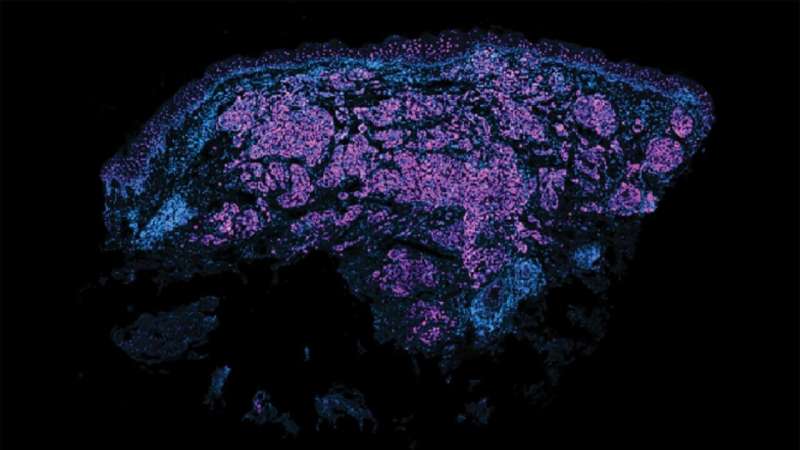
Metastatic lesions had far higher levels ofMALAT1(pink) than the surrounding tissues. Credit: Spector lab/CSHL
When researchers look for potential cancer therapy targets, they typically go after protein-coding genes that participate in disease progression. Disrupt them and negate whatever role they play in cancer's development or spread. Researchers at Cold Spring Harbor Laboratory (CSHL) have also been working on another kind of target. They're studying a long non-coding RNA calledMALAT1. So far, it's been linked to more than 20 different types of tumors.
In a new and unique studypublishedinMolecular Therapy: Oncology, CSHL researchers track MALAT1 levels over the course of one woman's experience withtriple-negative breast cancer(TNBC). They find that MALAT1 levels were high at diagnosis and decreased while the patient received standard treatments. Yet, perhaps most importantly, the level increased at a distant metastatic site. The researchers see this as supporting a role for MALAT1 in TNBC's spread.
The study allowed CSHL to interrogate this potential treatment target like never before. "Even though MALAT1 has been implicated in different cancers, includingbreast cancer, nobody has looked at how MALAT1 levels change over treatment anddisease progression," says Disha Aggarwal, the graduate student who spearheaded the study.
Researchers examinedtissue samplesfrom a 59-year-old woman diagnosed with stage 1 TNBC. The patient underwent different treatments over two and a half years, including surgery, chemotherapy, radiation, and immunotherapy. After a period of regression, the cancer became metastatic. Unfortunately, three and a half years after diagnosis, the individual succumbed to the disease. However, what she left behind will hopefully help others.
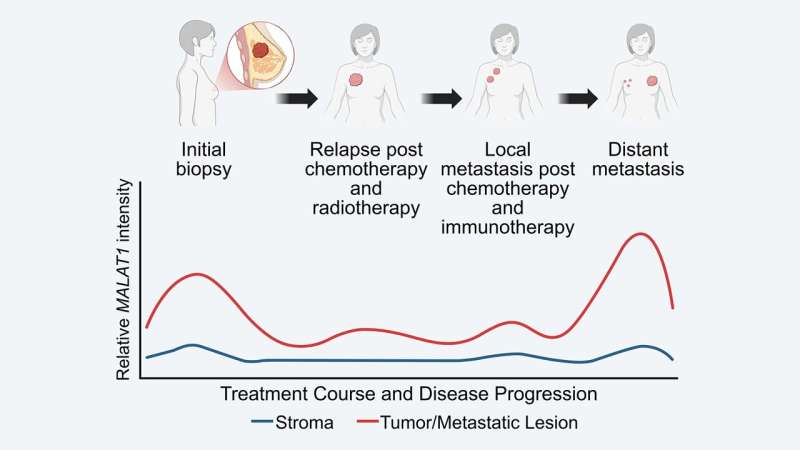
As illustrated here, levels of MALAT1 were highest at initial diagnosis and in a distant metastatic site. The finding suggests that MALAT1 plays a role in enabling triple-negative breast cancer to spread throughout the body. Credit: Spector lab/CSHL
Studying tissue samples from throughout the course of treatment and disease progression presented a rare opportunity, says CSHL Professor David Spector. "Researchers typically get to see an initial sample and an end sample, but not progressive samples in the depth that we were able to look at here." What they've seen may eventually inform future treatments.
Since 2015, the Spector lab has been collaborating with Ionis Pharmaceuticals to develop adrug targeting MALAT1. They're now speaking with biotech companies in hopes of launching a clinical trial within the next few years. But that's not all.
Spector's lab is also exploring whether MALAT1 could enable doctors to predict the risk of someone's cancer recurring or becoming metastatic. If so, it could not only guide therapeutic strategies for women who have been diagnosed with TNBC. It could factor in for those with more common and less severe forms of breast cancer.
More information: Disha Aggarwal et al, Longitudinal tracking of MALAT1 level over a breast cancer patient's course of treatment and disease progression, Molecular Therapy Oncology (2025). DOI: 10.1016/j.omton.2025.201070
Provided by Cold Spring Harbor Laboratory








Post comments