































by Jacqueline Mitchell,Harvard Medical School
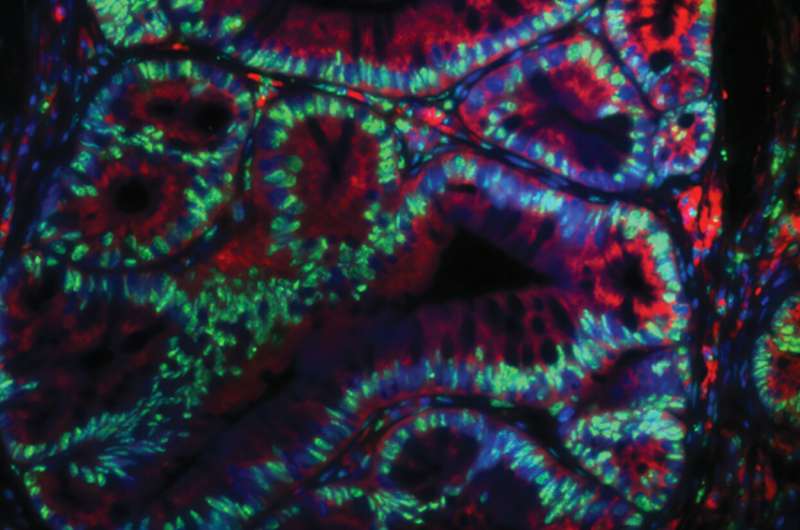
In mice lacking the COSMC gene, gut cells underwent vast changes in appearance and gene activity that predisposed them to develop into colorectal cancer. Here, green and red indicate abnormal expression of cancer-associated growth factor pathways in rectal cells. Credit: Courtesy of Richard Cummings
A new study has answered a question that has puzzled cancer researchers for decades: Does a genetic defect found in nearly all human colorectal cancers simply accompany the disease, or does it trigger its development? A team led by Harvard Medical School researchers at Beth Israel Deaconess Medical Center showed that replicating the genetic defect by deleting a single gene called COSMC (C1GalT1C1) in cells lining the intestines of mice led to the development of invasive colorectal cancer within a year.
The work, published in theJournal of Biological Chemistry, settles the longstanding debate over whether this genetic defect is a cause or consequence of cancer. If the findings translate to humans, they could inform new strategies to combat the third most commonly diagnosed cancer in the United States.
"We've demonstrated that losing this single gene is enough to trigger the entire disease process," said senior author Richard Cummings, the HMS S. Daniel Abraham Professor of Surgery and division chief of Surgical Sciences at Beth Israel Deaconess as well as director of the HMS Center for Glycoscience.
Colorectal cancer is projected to cause more than 55,000 deaths in the United States in 2026, making it the second-leading cause of cancer death after lung cancer, according to the American Cancer Society. Whilerateshave generally fallen in the past few decades, they are rising in people under 50.
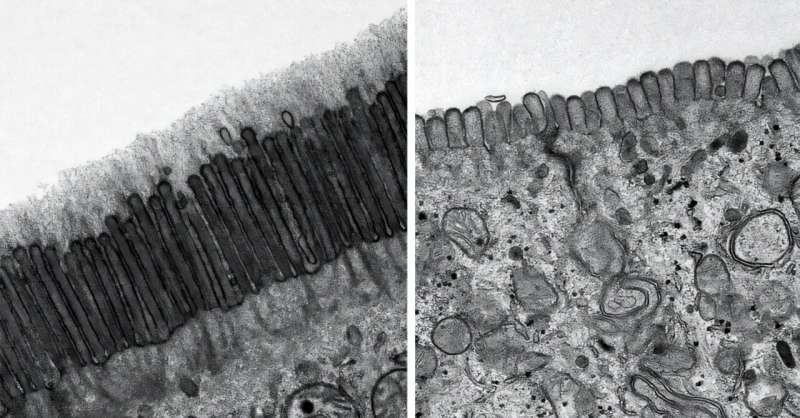
Loss of COSMC led to shortened villi in the colon (right) compared to normal mice (left). Credit: Richard Cummings
The new discovery illuminates a cause of—and potential target for treating or preventing—colorectal cancer, but it is likely not the whole story. Research has uncovered numerous factors that can contribute to risk of developing colorectal cancer, ranging from various gene mutations to sex and ethnicity to lifestyle factors like diet and smoking. Scientists are also investigating many other potential causes of the disease.
Cummings had been studying the role of the COSMC gene since changes in its DNA sequence or expression had been linked with colorectal and certain other cancers.
COSMC is essential for building the protective mucus layer that shields intestinal cells from trillions of gut bacteria. If the gene stops functioning properly, that protective barrier—normally thinner than the wall of a soap bubble—vanishes. Intestinal cells lose an important line of defense and become vulnerable to the damage that leads to cancer.
In the current study, deletion of COSMC led to an array of changes in the cells' characteristics and behavior. The majority of the mice developed colorectal adenocarcinomas, some of which were invasive (metastatic). The tumors occurred in the rectum and lower colon of the animal models—the same region where most human colorectal cancers occur.
When COSMC fails, a common marker of cancer known as the Tn antigen appears on the cell surface. The team's laboratory analyses confirmed that all the tumors in the study expressed the Tn antigen, verifying they arose from COSMC-deficient cells.
"We've shown that the same molecular change found in the vast majority of human colorectal cancers is sufficient on its own to cause tumors to develop," said Cummings.
Because the Tn antigen appears on the surface of cancer cells but not on healthy cells, it represents a promising target for precision therapy. The research team is now developing a monoclonal antibody that targets the Tn antigen on tumor cells as a potential treatment for colorectal cancer and other malignancies where Tn is expressed, such as many breast, ovarian, prostate, lung, and pancreatic cancers.
Publication details Tongzhong Ju et al, Deletion of Core 1 β3GalT-specific molecular chaperone (Cosmc) in murine intestinal epithelia leads to major alterations in glycocalyx and tumorigenesis, Journal of Biological Chemistry (2026). DOI: 10.1016/j.jbc.2026.111319 . www.jbc.org/article/S0021-9258(26)00189-4/fulltext Journal information: Journal of Biological Chemistry







Post comments