































byUniversity of Adelaide
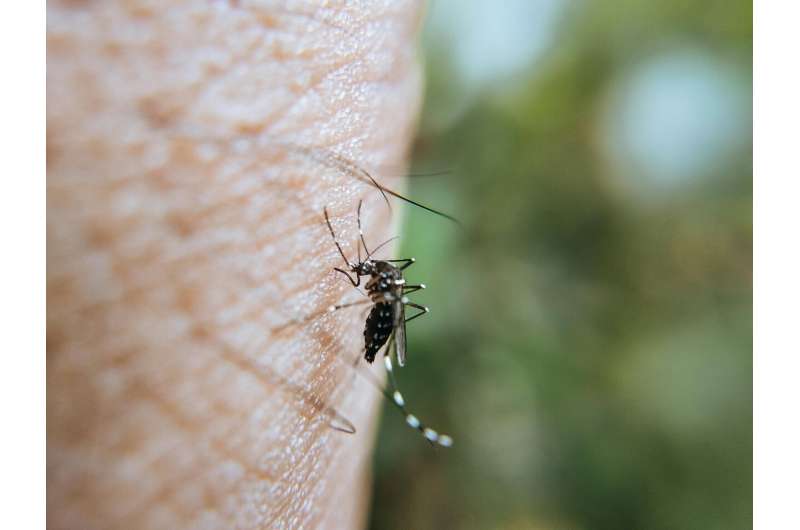
Credit: Ravi Kant from Pexels
Australian holiday-makers are being urged to prevent mosquito bites this summer, after research mapping studies from across the country found that warmer temperatures heighten the risk of Ross River Virus outbreaks, especially in riverland and coastal regions.
The scoping review, led by the University of Adelaide, and published today in theAustralian and New Zealand Journal of Public Health, also uncovered a knowledge gap when it comes to understanding the impact of temperature on Ross River Virus notifications within inland Australia.
Ross River Virus is a common mosquito-borne disease in Australia, with around 3,000 cases reported annually. It can be spread by more than 40 different species of mosquitoes, and hosts can include kangaroos, wallabies, bats, horses, and dogs. It can cause a rash, fever and joint pain (arthralgia). While most people recover within weeks, in some cases symptoms, specifically joint pain, can persist, hindering quality of life.
Researchers conducting a scoping review analyzed 30 studies related to the virus and temperature in Australia, finding that Ross River Virus risk increases when temperatures rise, but there were differences across geographic regions.
"Studies found that maximum temperatures are linked to higher Ross River Virus cases in coastal Australia, particularly in Queensland (Brisbane, Cairns, Townsville, Mackay, Gladstone, Bundaberg, Redland and Darling Downs), New South Wales (North-East NSW), Tasmania (Sorell region), and WA (Mandurah).
"Some studies found that minimum temperature appeared to increase the risk of the Ross River Virus infections in Darwin and in some inland regions of SA, Victoria and Queensland," says lead author Christina Mary Varghese, from the School of Public Health, University of Adelaide.
"It is very hard to predict Ross River Virus outbreaks, with a complex range of factors contributing to increased risk, including rainfall, humidity, and stagnant water conditions. But we know that cases are more likely when temperatures are between 17 and 31 degrees, with infections spiking when temperatures are around 26 degrees. That's why it's important for Australians to protect themselves from mozzie bites over the Christmas and New Year period."
The study also looked at the evidence on Barmah Forest Virus, another common mosquito-spreading virus, finding that the risk was linked to minimum temperatures in both coastal and inland areas.
"One of our biggest findings was that studies of Ross River Virus and Barmah Forest Virus have mostly centered on the coast. There is very little data on smaller towns and few related to the Ross River Virus in Queensland," says Varghese.
Particularly during summer, traveling and camping outdoors, researchers say Aussies should take precautions by wearing light-colored clothing, using mosquito nets and mosquito repellent creams on unexposed skin.
"When it's summer holidays, more of us are likely to be out and about, swimming, camping, and fishing, increasing the risk of mosquito bites. While not all mosquitoes carry Ross River Fever, it's wise to be careful. Mosquitoes can also cause illnesses such as Barmah Forest Virus and Japanese Encephalitis," Varghese explains.
Senior author Professor Peng Bi, School of Public Health, University of Adelaide, says that the study also exposed a knowledge gap about how the number of cases in different regions might be influenced by climate change scenarios.
"There has been no Australian based study assessing associated health care costs, nor projecting future disease burden under different climate change scenarios—this is a key knowledge gap that needs to be addressed. We need to better understand how our changing climate is going to influence risk in different regions.
"We also need to fill the big gaps in research across inland Australia—so we can track how things change over time."
Terry Slevin, CEO, Public Health Association of Australia, says that Australia's new Centre for Disease Control, due to launch officially in January, will need to watch these issues closely.
"As the Australian weather warms due toclimate change, we are likely to see different parts of Australia exposed to mosquito-carried diseases like Ross River Fever and Barnah River Virus. Australia's Centre for Disease Control will be monitoring these issues and is already providing advice on mosquito bite prevention."
More information Christina Mary Varghese et al, The impact of temperature on Ross River virus and Barmah Forest virus infection in Australia: A scoping review, Australian and New Zealand Journal of Public Health (2025). DOI: 10.1016/j.anzjph.2025.100291 Journal information: Australian and New Zealand Journal of Public Health
Provided by University of Adelaide









Post comments